Retraining pain signals
Pain Reprocessing Therapy in Ireland
Pain Reprocessing Therapy may help suitable people of all ages with neuroplastic chronic pain by teaching the brain to interpret safe body sensations with less danger. One-to-one support is available online, with limited in-person sessions in Rochestown, Cork.
The method
What Pain Reprocessing Therapy does
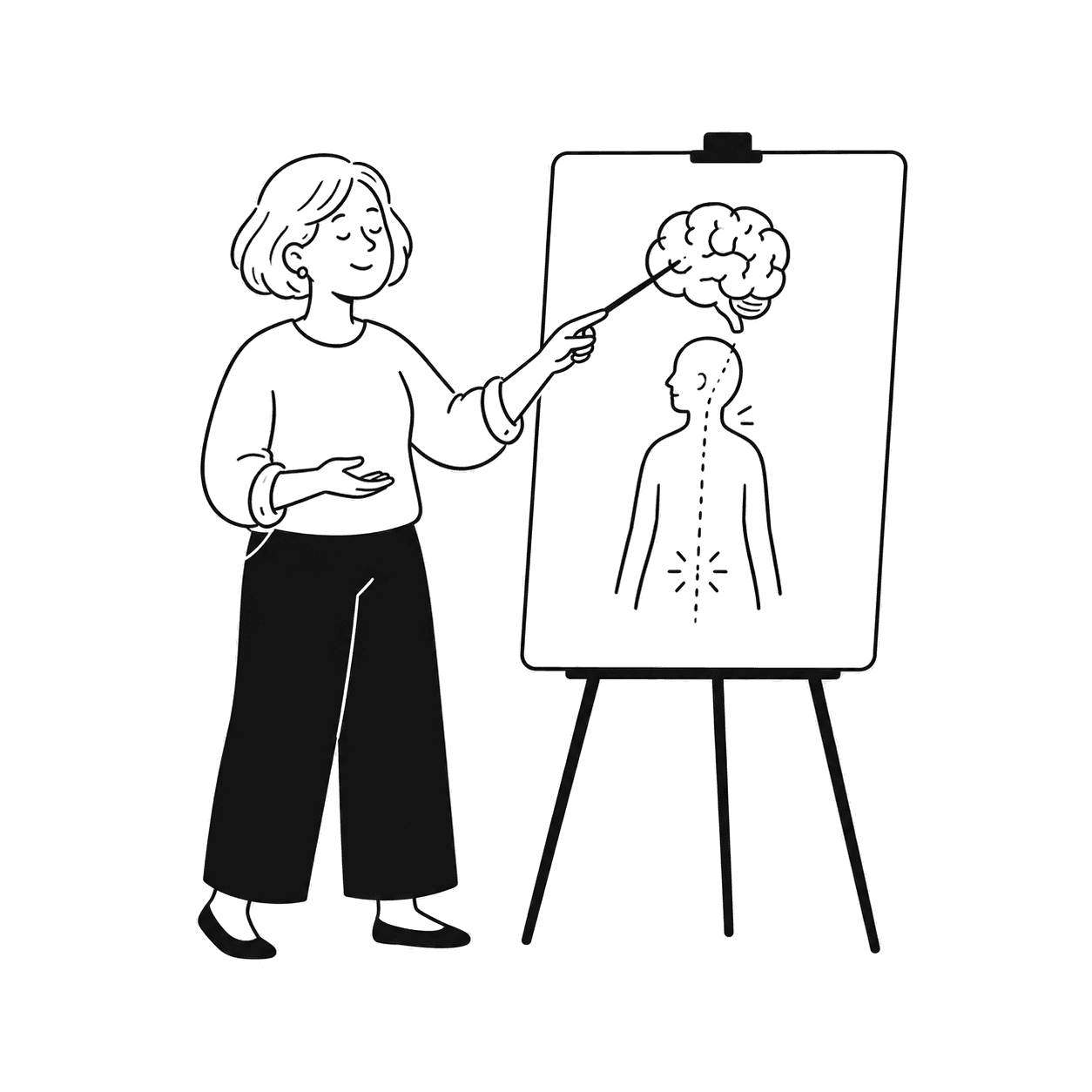
Pain Reprocessing Therapy, often called PRT, is based on the idea that some chronic pain is maintained by learned neural pathways rather than ongoing tissue damage. The pain is real, but the danger signal may be inaccurate.
PRT helps suitable clients observe sensations differently, reduce fear, and build evidence of safety. Over time, this may help the nervous system lower its protective alarm response.
What it involves
Education, safety and somatic tracking
A central part of PRT is learning why pain can persist after healing and how the brain can misinterpret normal sensations as dangerous. This education can reduce fear and create a foundation for change.
Somatic tracking is another key practice. It means paying attention to sensations with curiosity and safety rather than alarm, when it is appropriate to do so. This is not about ignoring pain; it is about changing the meaning the brain attaches to it.

Who it is for
When pain may be neuroplastic
PRT may be relevant when pain began without clear injury, persists beyond expected healing, moves around, varies with stress, improves with distraction, or has not been explained by medical tests.
It may also be explored alongside symptoms such as fibromyalgia, migraine, back pain, neck pain, IBS, pelvic pain, long covid-related symptoms, and chronic fatigue, as long as medical causes have been assessed.

Core principles
How the work supports change
PRT is not positive thinking. It is a structured way of helping the nervous system update its prediction of danger. One-to-one 60-minute sessions cost €70.
Pain is real
The starting point is validation. Neuroplastic pain is generated by the brain and nervous system, but it is still a real bodily experience.
Pain does not always mean damage
For some chronic pain, the alarm system keeps firing even when tissues are not in ongoing danger.
Fear amplifies signals
Fear, avoidance, scanning, and protective tension can reinforce the brain's danger prediction.
Safety can be learned
With the right conditions, the brain can learn that certain sensations and movements are safe again.
Research links
Evidence behind
this approach
These external research links are included for transparency. They do not replace personalised medical advice or assessment.
The Boulder Chronic Back Pain Study
Randomised clinical trial of 151 adults with primary chronic back pain comparing PRT with open-label placebo and usual care, with one-year follow-up.
View research02JAMA Psychiatry, 2025Pain Reprocessing Therapy vs Placebo and Usual Care: 5-Year Follow-Up
Long-term follow-up from the original PRT trial reporting durability of outcomes in chronic back pain. Useful context, while still specific to the trial population studied.
View researchBefore you begin
PRT is not for every pain condition
Pain Reprocessing Therapy should only be considered after appropriate medical assessment. It is not a replacement for treatment of active disease, infection, acute injury, cancer, urgent symptoms, or structural problems requiring surgical intervention.